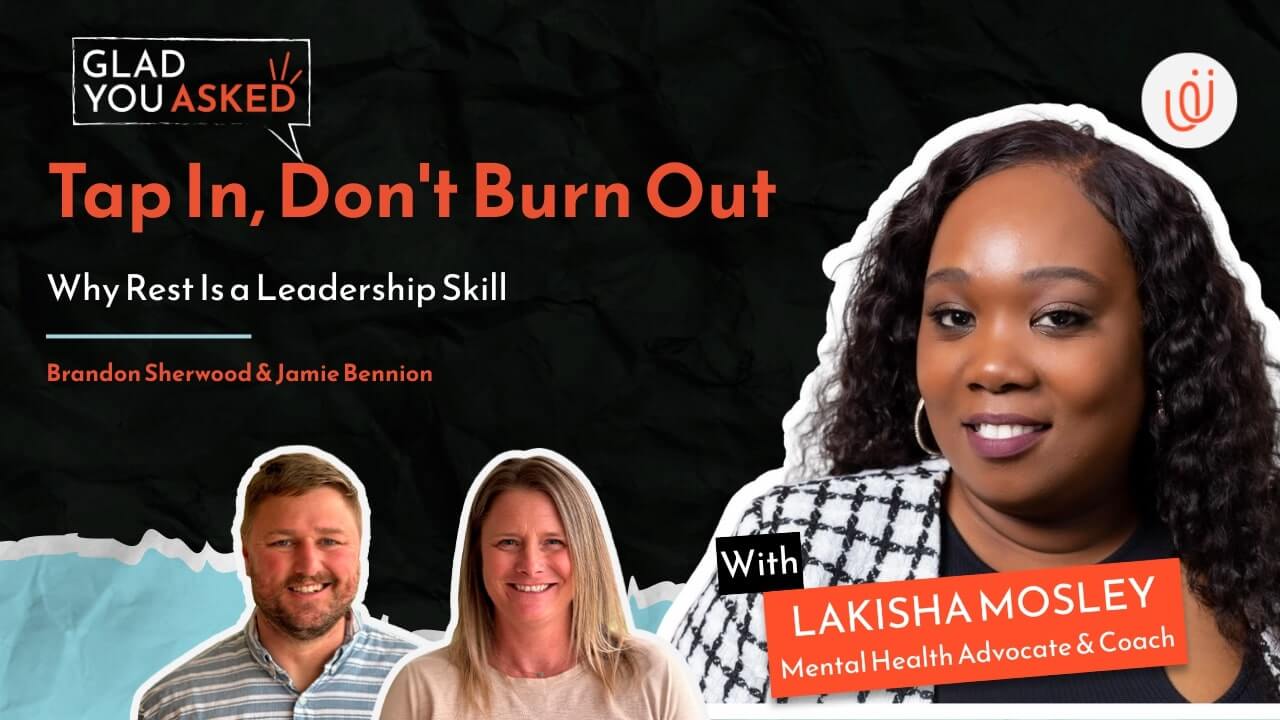
When our guest told us she literally throws her phones across the room to get five minutes of peace, Brandon and I exchanged the kind of look that says “we need to hear more.” Twenty minutes into discussing everything from Bluetooth toasters to chocolate-covered almonds, we’d already covered more ground than most formal interviews. But that’s the thing about real conversations, the best insights come when you stop trying so hard to find them.
What struck me most wasn’t just the message about rest and mental health. It was how it was delivered, with the kind of hard-won wisdom that only comes from crashing into your own limits and deciding to rebuild differently.
The First Gladly Voice Who Gets It
LaKisha Mosley responded to my cold Instagram DM (yes, that actually works sometimes), and became our first official Gladly Voice. But she’s more than a title. She’s someone who helps people, especially women, understand that rest isn’t a reward you earn after completing an impossible checklist.
Her philosophy cuts through the noise: “Rest isn’t a luxury or a reward for doing something. Rest is what naturally is ours. Like it’s a reset button that allows us to show up for the things that matter.”
As someone building a business while trying to maintain some semblance of balance, those words hit differently. They challenged everything I’d been taught about success requiring constant motion.
Why We Worship at the Altar of Exhaustion
Our conversation exposed a truth that made everyone pause. We’ve been raised in a culture that treats being tired like an achievement. We wear “I’m so busy” like a badge of honor, as if exhaustion proves our worth.
“We were taught that if we’re not hustling, we’re not worthy. Like stillness is laziness. If you just sit down, like what you doing? Why are you not doing nothing? We were taught that success really only comes from struggle.”
Listen to why we’re fighting for things that should naturally be ours →
For women especially, this message runs deep. The expectation to care for everyone else first, to push through no matter the cost, and then call it strength. But here’s the question we’re all afraid to ask: what happens when that strength becomes self-destruction?
The Crash That Changed Everything
A few years ago, our guestlearned this lesson the hard way. Running multiple ventures simultaneously, she didn’t just burn out; she crashed completely.
“That’s when I learned that mind and body will shut down on you if you don’t get proper rest. And rest sometimes is just saying no. No, November, right? No, I can’t do it. I cannot do it.”
This resonated deeply with both my co-host and me. We’ve each had our wake-up calls. Brandon admitted his own recent reality check, while I shared how my wife has to remind me that “17,000 steps a day is not a brag”, it’s a warning sign.
Own Your Peace
When I asked why peace needs to be so personalized, the response shifted the entire conversation:
“Peace is personal. You have to decide, there’s a choice in all of this, what you’re going to let bother you. There are certain things now that it’s not that I don’t care, I’m not concerned, but can I change it? No. So am I going to wreck my peace behind it? No.”
LaKisha challenged the popular notion of “protecting your peace,” pointing out the flaw in that thinking: “We say let’s protect our peace, but are we really protecting anything? Why is it even out there to be trampled on? I’m not protecting my peace, baby. It’s mine. You can’t have it.”
Listen to why peace doesn’t need protection – it needs ownership →
The Five-Minute CEO Reset
What makes this approach revolutionary is its simplicity. No hour-long meditation sessions or week-long retreats to Tuscany required (though she painted a delicious picture involving Italian pastries and sun-warmed terraces).
The “Five-Minute CEO Reset” is brilliantly achievable: physically throw the phones away, find a quiet space (even if it’s your closet), and sit with gratitude. No apps. No guided anything. Just you and your thoughts.
“Some of my greatest ideas come from just sitting in my closet,” she told us. Apparently, that’s where some of the best collaborations begin – with ideas born in stillness that become emails to partners.
Redefining Self-Care Without the Spa Day
We demolished some myths about what self-care should look like. Our guest admitted that spa days actually give her anxiety: “I gotta watch you make sure you don’t cut my cuticles… You massaging me too hard. I’m scared. I’m not relaxed.”
My co-host finds peace driving deep into forestland where his car “wishes it wasn’t on that road,” sitting under aspen trees where everything else disappears. My wife needs to run; sitting still would make her mind eat itself. Me? I find clarity in the shower where nobody can reach me and I can think without interruption.
The lesson? Stop letting Instagram influencers or wellness gurus define what restoration looks like for you. Your rest might be movement. It might be stillness. It might be mindless phone games for five minutes. What matters is that you claim it without apology.
Pay Your Future Self First
Brandon dropped an analogy that stopped us all: “We all know the financial advice that you pay yourself first, right? You take your percentage and put it into savings. We don’t apply that to time in any way, which I think is more valuable than money.”
Before booking your week with obligations to others, book time for yourself. Not with whatever scraps remain at 1:30 AM when everyone’s asleep. First.
Our guest takes this seriously, blocking off “CEO days” on her calendar. “That’s my day. Don’t come in here, don’t bother me. I have a fridge in my room. I don’t have to leave.”
How This Conversation Changed My Perspective
Hearing about grace, not the religious kind, but the kind you give yourself when you slip, I kept thinking about my own journey. The constant push, the guilt when resting, the belief that stopping meant failing.
But here’s what I learned: when business owners actually rest, we think better. We create better. We show up better. It isn’t a luxury or a reward — it’s straight strategy for business owners.
The most powerful moment came with these words: “Naps and grace, baby. We don’t talk about them things enough.” In a world that celebrates grinding yourself into dust, celebrating the revolutionary act of taking a nap at 5 PM and calling it exactly what it is – a nap, not “going to bed early” – feels like rebellion.
This conversation reminded me why we created Glad You Asked. Sometimes the most radical thing you can do is give yourself permission to stop. To rest. To throw your phone across the room and sit in your closet with nothing but gratitude and silence.
Ready to Reclaim Your Peace?
Your exhaustion isn’t a trophy. Your burnout isn’t proof of dedication. This conversation proved that the most successful leaders aren’t the ones who never stop; they’re the ones who know when stopping is the most strategic move they can make.
Want the full conversation, including the great Bluetooth toaster mystery and my co-host’s confession about sleeping through Kansas?
Listen & Watch the Full Conversation